|
For more information, please scroll to the bottom of the page. |
| TABLE of CONTENTS |
 The Postwar Era
Occupied Japan
In all of my collection there is not a single house marked "Made in Occupied Japan." Throughout my collecting years , I had seen one or two very tiny flat-based and uninteresting simple houses marked Occupied Japan, but they were actually tree ornaments and not strictly village houses. Just recently, however, a few medium sized box-based examples of the 4 1/2 by 3" to near 6"sizes have been coming to light, and some near prewar style - actually fairly interesting of design and complex.
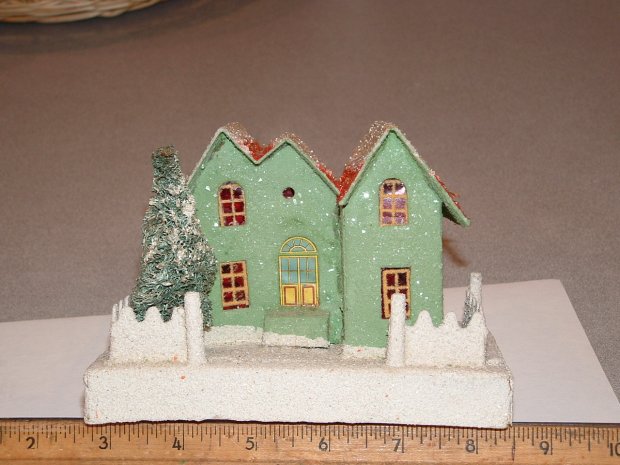
Barbara Healy just sent me these pictures of a recent aquisition to her collection. Immediately, there are several solid facts established, here. For one, the paper front door is original and of our repro type "PWD-3," which I had thought to be late prewar. This proves it existed on both sides of The War. The roof is "coconut," and the house has flocked mullioned windows - proving both these features existed pre and postwar.

The house is of an interesting complexity that had i not seen the rubber stamp, I could well have thought it a prewar piece. Perhaps it was. A revival of a prewar type to get things up and running again immediately following The War until the newer, simpler designs could be initiated. The more I see, the more I am convinced that these early complex ones were "New Old Stock" - stamped with the mandated lable and gone before 1948. The United States occupied Japan from 1945 to 1952, but dropped the mandate to label exports as "occupied" in 1948, so this is a very brief period, indeed, because we find more in of these larger ones in early'50s styles and colors with the "occupied" stamp on them.
I have a lot of postwar Japanese houses. They seem to be quite plentiful and the easiest to find. It appears that there was a furious resurgence of the Japanese Christmas house that started during the occupation period and continued for about ten years. After about 1955 the size and complexity petered out rapidly into ever less interesting designs until Cristmas decoration manufacturing went almost totally to Taiwan by the early to mid '60's. In the '60's, Japan is anxious to "upgrade" Her industrial status before the world, leave Her former image as the "Queen of Kitch" behind, and go "high-tech" all the way. We are all familiar with the way that that turned out. They still refuse to talk about it or provide any company names or other documentation. Believe me, I've tried! But what a shame to leave this period of astounding creativity behind. It's ironic, I think, that the hi-tech stuff is hopelessly obsolete and on it's way to landfills in under 5 years, while people have preserved these "kitchy" little dimestore things for sometimes a century! - a shame there wasn't room for both, i9n their minds, but deeper and less innocent things were happening to Christmas.
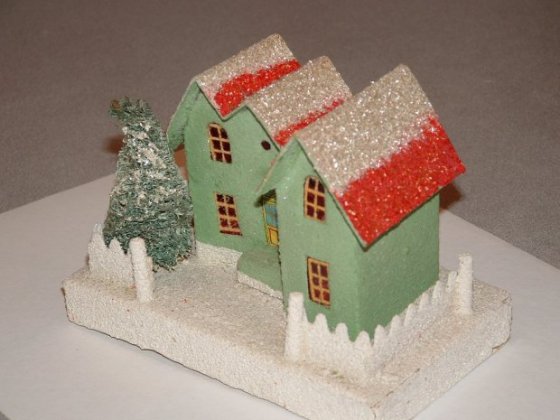
An oblique view.
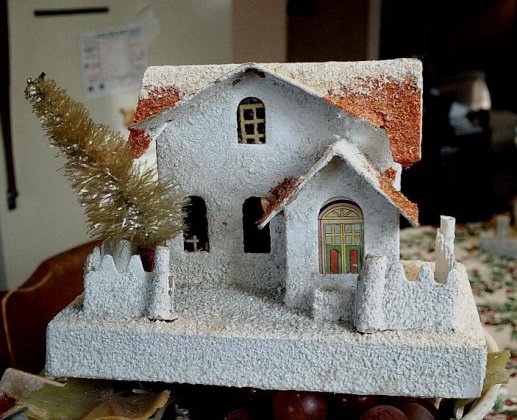
Here's another early occupied Japan from Tom Hull. This one has the "PWD-4" paper door and the fences more like the prewar. Larger than it appears, this one is about 6" wide.

Oh, those 'Fifties!
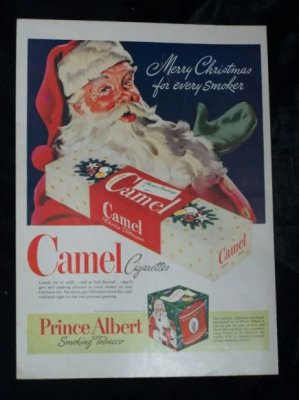
World war II had struck the American Christmas "Putz" a mortal blow, but it took a while to really show. For me the Old Christmas was over around 1954-55 when "Rock n' Roll" took over and almost everybody had TV and an aluminum tree - and pretty much put nothing underneath that tree but trendy presents. Up till then, Christmas - as it had been - seemed to be going exceptionally strong, but was really the last, desperate battle of a lovely old dream to survive.
As The War closed and millions started coming home they wanted it to be what they had known and dreampt of, but it was not to be. Too much had happened and been seen, but they really really tried. In the immediate post-War years most all the great Christmas movies now considered "classics" were produced. Many of the greatest songs . We met "Rudolph" and "Frosty" and the bubble lights. Lionel and Gilbert American Flyer were doing land-office business in whole new lines of trains. But the little cracker-box Levittown style "cracker box" houses they were slapping up were just too small and didn't lend themselves to setting up large layouts and displays. Despite their best efforts, Madison Avenue was having only marginal success in getting liberated "Rosie the Riveter" back into an apron and high heels in a "Donna Reed Show" / "Father Knows Best"- type kitchen. The Kinsey Reports came out and forever put the kibosh on our "Juney-moon" illusion of American romance. Then in '49 - Russia got The Bomb. The Cold War was on. Paranoia and McCarthyism gripped us in a toxic, witch-hunt spirit. "Duck and cover." "Commies" this - and "Commies" that - and then we had another war, only this one didn't go so well - and the one to follow far worse still -
- all of which resulted in the Counter-Culture Revolution of the '60s.
In 1954 The grand old Lionel Corporation had its greatest year ever and came to an end. Founder and prime-driver Joshua Lionel Cowan sold out and retired. Talk about timing the market! The next year traditional electric train sales went over a cliff and never stopped falling. Oh, there were "Lionel" trains, thereafter, but never the same. Lionel went through a succession of mismanaging corporate hands and by the 60's their products were far fewer and a pathetic shadow of the quality they'd once been. The old-style 3-railers had been pretty much eclipsed by HO and the new slot-cars. American Flyer paralleled in decline. By the '60s those massive, heavy metal engines that had commanded such respect were lightweight plastic junk. Christmas wish-lists were filled primarily with fad-toys being hyped on TV.
An equally profound transition was taking place in the Christmas decorations we were finding in the stores. Japan was anxious for that total image make-over into high-tech all the way. The Christmas junk was coming evermore from Taiwan. The cardboard houses enjoyed one "Last Hurrah" around 1955 and then went into a rapid and fatal decline. By the mid '60s you could get little more than simple little flat-card based houses meant as ornaments for the tree. Bubble light strings were reduced from 9 sockets to 8 and burned too hot and melted. The sub-miniature "fairy lights" we all use today were rapidly displacing the old familiar C-6 bulbs. For about a decade we all welcomed this newness and embraced it.
But then - around about the early '70s - something was in the air. Suddenly, a lot of people began to miss the old things. Collecting - especially of trains and the old Christmas things - started up quite suddenly and on a massive scale and has continued, Putzing has come back though with some new wrinkles. People have always had a fascination for all things miniature, and by the 90s putzing and trains had made a huge comeback, even in the general population. The houses were mostly ceramic , the trains a new breed, but very much in keeping with the old. There are present ly more tinplate trains being being made - and sold - by more manufacturers than ever in the old days. More "Big Bands," too, even though they don't play them on commercial radio. Much of Old America's taste for Christmas has once again arisen "in the blood." This I'm glad to see. We had nearly thrown out all our dearest babies with the bathwater.

Immediate Postwar Era
Plastic Town Lightcovers

I remember seeing a lot of these hard-plastic lightcover houses around in Johnstown, PA just at the end of the war '45/'47. Not sure who made them -Possibly RayLite, the people who made those plastic lite-up churches and altars that were also big at the time. Postwar America was nuts about plastic; we thought it was a great thing. I include them because they're Christmas houses and because I've seen them used not only on the tree, but as little villages beneath little trees. They are basically awful. The whole house glows when the light is lit and the back is fully open. There are 8 different (just as with the NIPPON cardboard house lights of the '30's,) enough to accomodate the standard 8-lite C-6 string. Each can be found in 4 basic colors. T here is also a series of 7 larger versions to fit the C-7 110 volt lights, but I haven't enough of those to show. They tended to melt with the heat of the larger 7 1/2 watt bulb.

The covers were held to the neck of the bulb by this sliding stamped-metal piece, which is often missing.
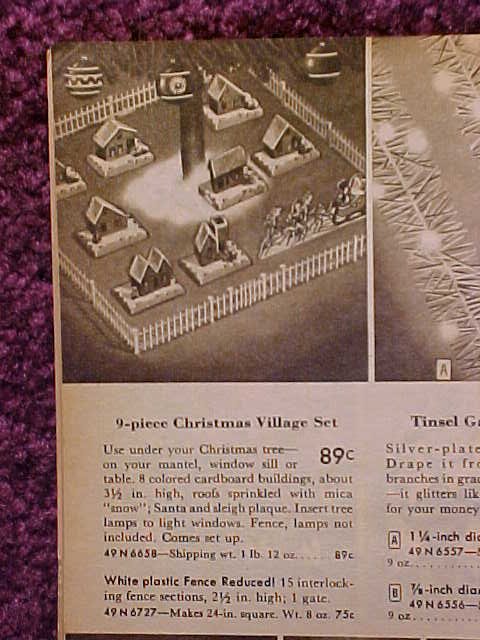
From Sears Christmas Wishbook 1949
In 1949, Sears is offering only this small "9" piece Colmor or Dolly Toy set. 8 nondescript houses and a 2-dimensional standup cardboard Santa and sleigh. The hard-plastic fence was extra.
The "FIFTIES"
Next we come to typical larger grade houses of the 1950-'55 period. It was suddenly possible to find large and elborate Japanese things again - close to the prewar richness - a brief period I think of as -
The "LAST HURRAH"
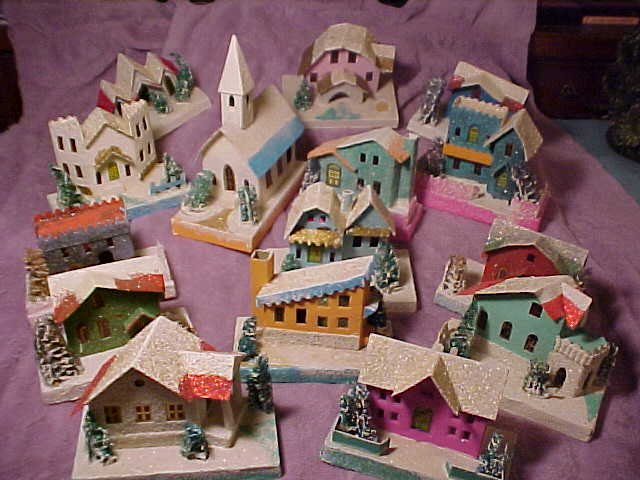
A bloom of larger, more interesting things appears ...

This series of 2-tiered bases with excessive landscaping, for example, somewhat recall the "Pagoda" house seen in the 1920's section.

Sears Christmas "Wishbook" - 1955:
This is typical of what was available in the mid-'50s, Better, larger things in the same style could be had in the 5&10s and department stores. Not since the early '30s had mailorder houses offered even the moderately large and fancy sets. I think they limited themselves to what was safe and easy to ship. Christmas "wishbooks" are disappointing for this reason, though they do explain why we find so many of these uninteresting little things why they are so common. It's the same with many toys and trains sets. If you could buy it from the Sears or Ward's catalogs, you are liable to find it anywhere! But note the bases on these: no matter how fancy and desirable or complex the house, if it has a two-toned wash around edge of the base it is mosty likely POSTWAR. It's most often the white of the base top with a band of color around the bottom, or a solid but contrasting color from the top. A similar treatment appears on some of the PreWar Hacindas, but in harsher colors. The fifties houses are usually more pastel. But not always. After a while, you just get a feel for it. Experience is the only way.
Spiegel Christmas "Wishbook" - 1955: p. 181
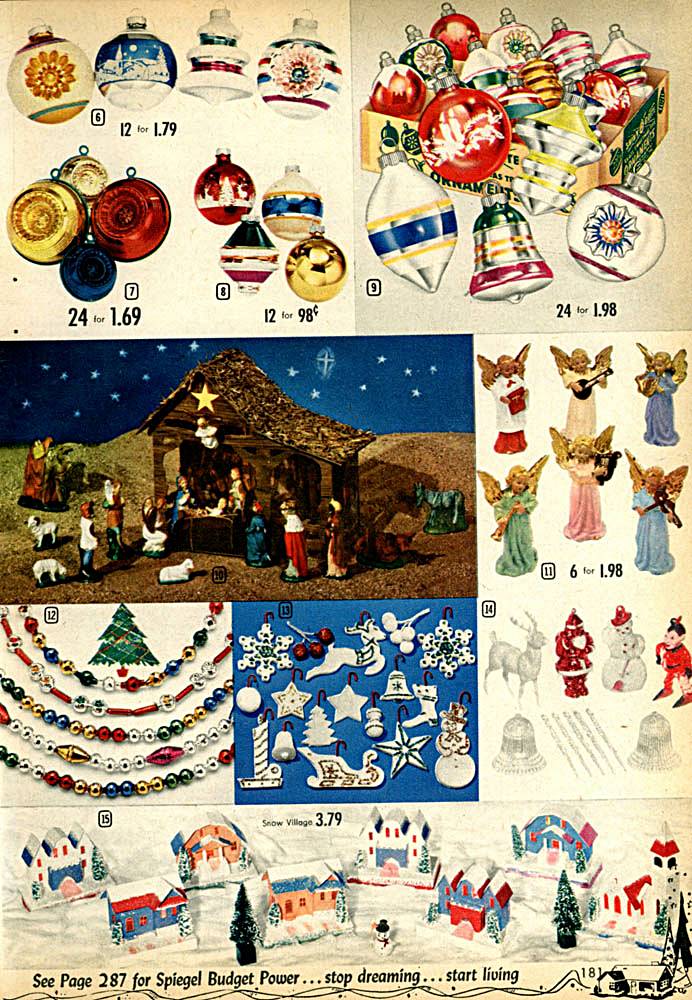
Here are some better ones from the period. Not quite PreWar, but very nice. 1955 seems to have been the pinnacle of the "Last Hurrah" , because it's a downward spiral from there into the 60s where they become pathetic shadows of all that had gone before.

The COTTON-TOPPERS
Some of the largest and nicest pieces of the "Last Hurrah" are the COTTON-TOPPERS. These are definitely postwar, but harken back to some of the sizes and earliest structural features of the prewar - and also especially the figures and cotton-batting roofs which were commonly found on '20's candy-boxes. Some of the churches are remarkably large and resplendent and some are of wholly new design. The huge church rear center is 15" tall! The Cotton-Topper group is very heavy on large churches. I am not sure of the exact year, but it's a big part of that "Last Hurrah" of the mid '50s. Right now I'm betting on 1955.
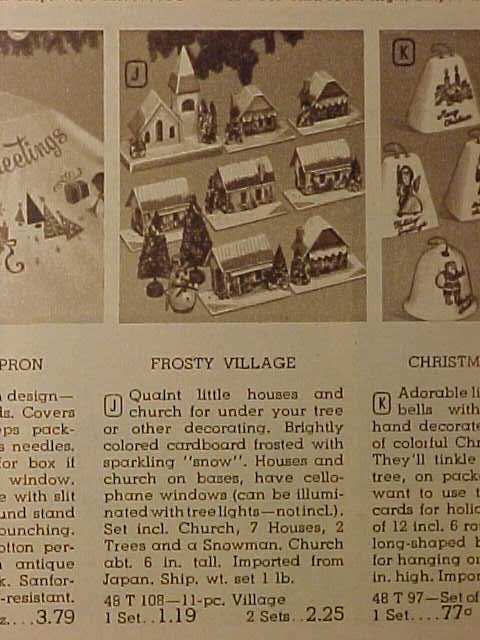
Ward's Christmas "Wishbook" - 1956:
It's apparent that it made a big difference where you shopped for houses. Ward's was always the low-end of the mailorder lot. Compare the prices on these village sets. In the '50s, you pretty much got what you paid for. But here in 1956, already, the quality seems to have just tipped over the rim of a cliff.
The M & K PRODUCTS COMPANY
of Mogadore,Ohio

I don't know how to classify these. I kind of have a hunch they predate the Japanese "Last Hurrah" discussed above. I've got a '40s feeling. This is a remarkable set in many ways - including UGLY! The pieces are quite large, extraordinarily sturdy and somewhat nicely designed, but somebody's aesthetic taste switch was definitely in the "off" position when they chose to cover most of them in black glitter! If you wanted to capture the sooty filth and grime of a typical coal-burning American mill town, these were the houses for you! Tom Hull has suggested the glitter was originally silver that has blackened over time, and I'm inclined to think that could be the case. They would have looked SO much better! These are definitely rare. A market failure for sure, and it's sad, really. Whoever designed them was selling extra-durable quality, making the mistake we made back then that the Japanese houses were just flimsy junk that could never last ....
Unprepossessing as they are, they're nonethless quite rare - but who cares?

Each house has a metal clip, screw-mounted on a wooden block to hold the socket of a C-7 sized candelabra bulb in firm position. This is the only example of such a thing I've ever seen in the world of cardboard Christmas houses. This clip had come loose from one of the houses but was fortunately still in the set box, so I took the opportunity to photograph it before gluing it back.


The set was also provided with it's own string of 5 C-7 lights (7 is the standard string.)The fact that the wire is plastic insulated also sways my assessment of the time period to the postwar. Three of the houses had numbers stamped on the bottom : #2,#3, and #6. Whether this means there were more types of these houses, or that there were 6 elements to the set (the light-string being one of them) - I do not know. I have seen individual houses like this on eBay, but they were one or another of the 5 types shown here.


A second boxed M & K Products set has recently (March, 2005)come to light. This one with 3 buildings.
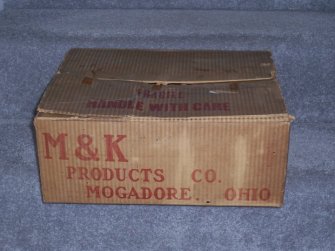

This smaller set had it's own string of 3 C-7 lights. In both cases,the boxes are extraodinarily rugged; double-weight cardboard. Compartmentalized. Total overkill. One wonders what they were anticpating. They seem designed to be airdropped from a C-130 "Flying Boxcar" into a battle zone.

A very odd and curious chapter in the Christmas house history. I doubt the company was in business for very long. It's one those cases seen throughout the Christmas house history where someone sought and failed to beat the Japanese on quality becaue they fought the wrong battle on quality. The literal Western Mind went after the technical and mechanical, whereas the real quality was the fanciful and capricious Japanese aesthetic - which was often technically absurd, but absolute "eye-candy" on the dimestore counters. The American practical mind could offer no real competition there. These battle-worthy M & K houses seem to turn up mainly around eastern Ohio and Western Pennsylvania, and not have acheived a very widespread distribution. They were probably too expensive to interest the mail order people and the novelty retailers. If anyone has further knowledge of this company and it's history, I'd certainly like to hear from you! These were absolutely new to me when I stumbled across them.
The 1960's:
This is where it ends - in the 60's-
-like one of those rivers that runs out into the desert , growing thinner and thinner-
- and finally just disappearing into the sand..........
I guess when you think about it, they didn't fit with Eammes and Danish Modern furniture. "MOD" clothes and all that slick, urbane stuff on TV. They were anything but "cool" as it was thought of then.
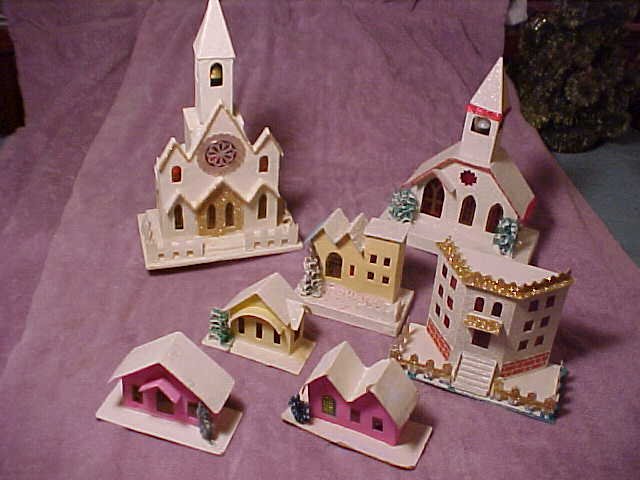
Typical of the last of the Japanese ca. 1960. Very light construction, light coating. Oddly, Japan exports a number of these very large churches with a built-in C-7 110 volt bulb and line cord around this time, as well as those odd mirror and glass shrine-like creche-like things with a single bulb inside. I have none to show you; they don't interest me. (Outside of my "Magic Window") There are a lot of these tiny flat-card types, at the end, that usually came in cellophane baggies of two or three - sometimes small boxes of a dozen. ... almost devoid of charm and detail. The dark-red glitter edging seen on the second church and the gold on the apartment style house are also charactistic of the dying days. Oddly, a distant vestige of the Printies is seen again in the brick work of it's foundation.
Novelty Light Sets:
Probably the hottest new thing to hit Christmas in the '60's were the tiny "fairy" lights. Some of the old C-6 series strings were still being sold up into the early part of that decade, but were rapidly displaced by these tinies, with so many on a string and burning so much cooler. I like them myself! The takeover by the "fairy" lights was to influence just about everything in Christmas decorating to come, lending themselves to a host of novelty-string applications, many of which were in the form of little houses.
The "ALPINE VILLAGES"
But it was nothing new. Let's back up a couple of decades, first -
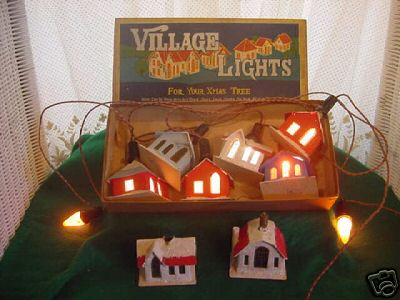
The original "ancestor."
The complete boxed set of what I believe to be the first of a continuing series of village light strings to become later known as "The Alpine Village," including those tacky open-backed white plastic things with decal fronts you find today. I doubt they'll ever totally quit making them in some form or other.
. These first date to around 1935. They're Japanese.
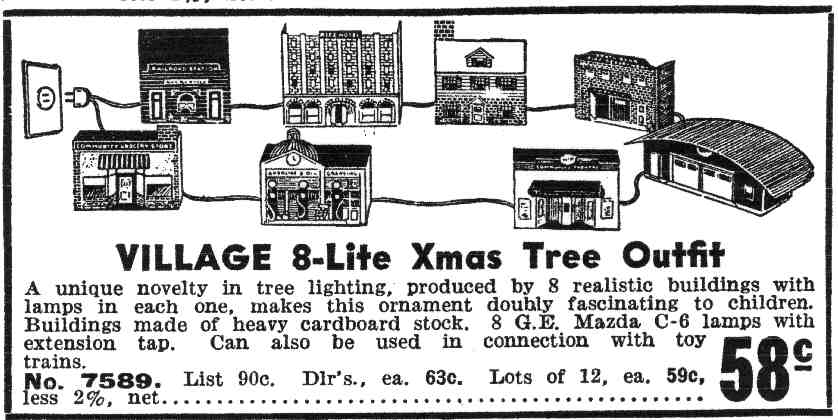
Here's a real oddball cardboard village light string of a kind I've never seen. Rita Dubas of Brooklyn sent me this. It's from the "ELECTRICAL RADIO CATALOG: 1937-38" from the HARRISON WHOLESALE COMPANY of Chicago. This appears to have been American made, with GE "Mazda" lamps, and seems too large and heavy to have been intended for hanging on the tree, despite what they say. Obviously lithography and reminiscent of the McLaughlin Bros. "Pretty Village" of the WW I era. Has anyone out there got one of these? I'd love to see an actual photograph.
Now to the actual named "Alpine Villages."

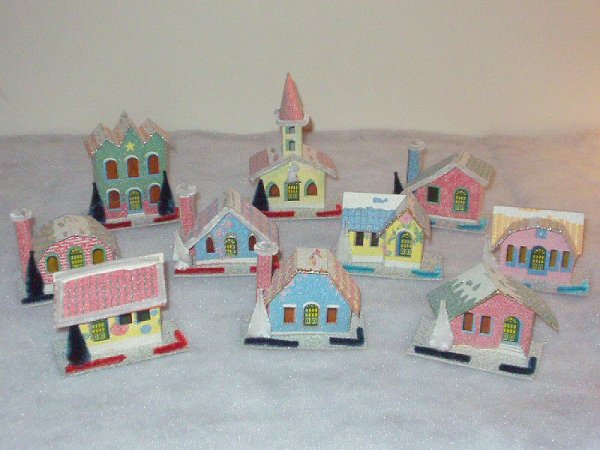
The mid to late '50s into the early '60s? I'm not sure, but these actually have considerable detail and charm, considering their postwar position in the saga. Probably fond childhood memories for late "Boomers" now approaching their 60s, I still see individual pieces in the flea markets quite often. Now I know where they came from.
We have Jana Pumbtree to thank for sending in these photos.
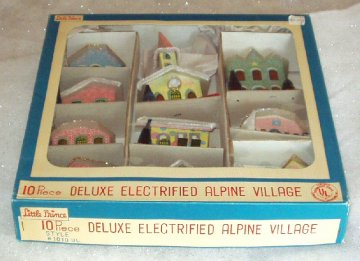

Later Version:
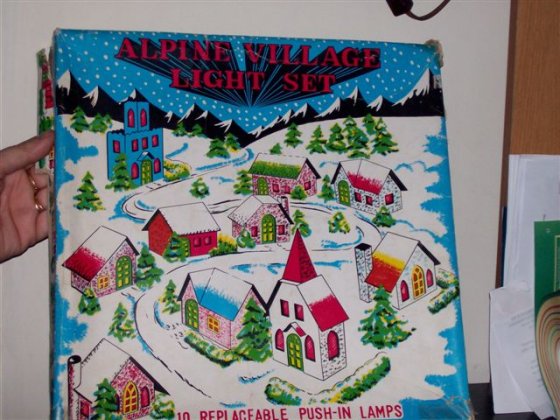
 Italian:
From the mid 60's into the '70's, the Italians - in particular - came out with a great number of novelty light strings in every imaginable shape - basically as plastic light covers with the 10 or 12 light strings illuminating them. Lights and houses have been inextricable bound up from the beginning - back to the latter 19th Century with European train buildings and doll houses that had little oil lamps and even candles inside. The Italian village set shown below is remarkable in that the covers are all light cardboard- not plastic, the tiny buildings quite interesting and well detailed in and of themselves. But the box says "Genuine Italian Novelty "Lights", not "Village", though they do make a cute little town under a small table-top tree. The only problem is that the buildings are so light that the stiffness of the wire makes it difficult to set them level and looking right and have them stay that way.
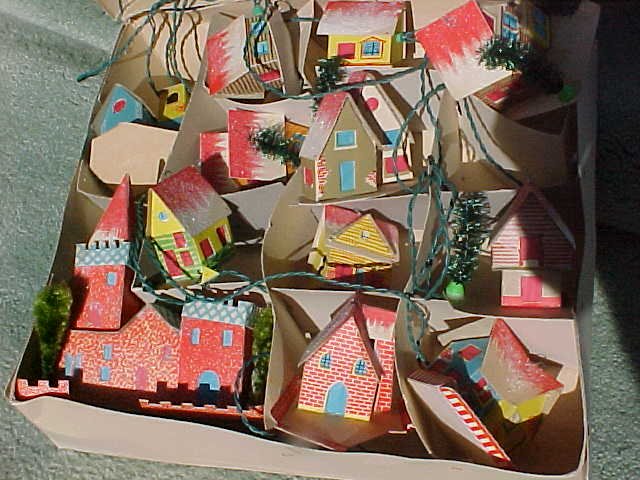
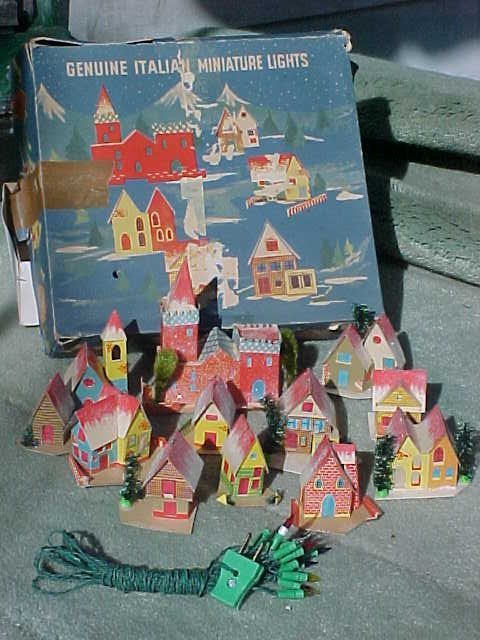
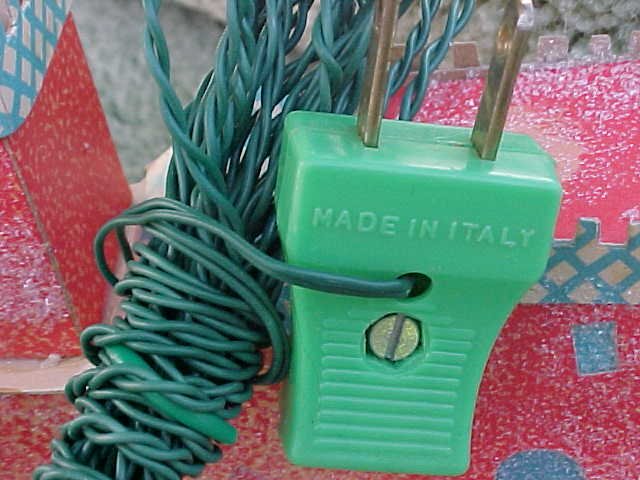
I show the plug marked "MADE IN ITALY" because there is a virtually identical set of Japanese manufacture called The Sleepy Village. I think the same people made both and put them in different boxes, haven't had the chance to examine the Japanese set to see if it has a "made in Japan" plug.
West Germany? Japan? US?

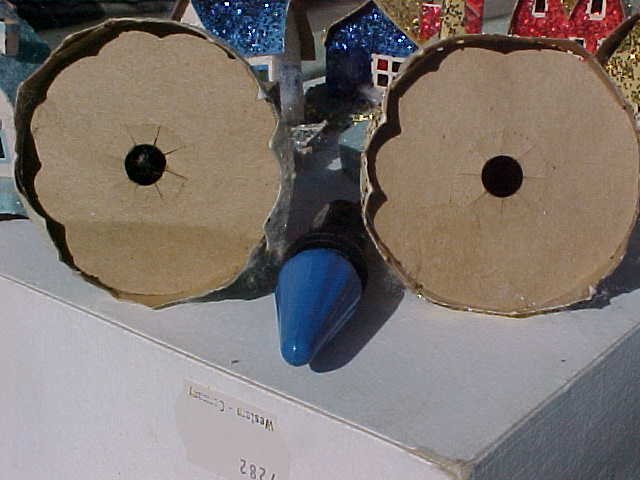
These tiny,curious and very delicate little exquisitely detailed houses came as a set of 12. You could get them either as ornamental covers for the modern "fairy lights" to put on the tree, or with a molded plastic scenic base, complete with pond, trees and figures that held 12 "fairy" lights of a 20-light string under the houses. A complete little "putz" for a mantel or sideboard display. (See the scan of the magazine or cataolg ad below.) These have to be from the '60s, though I am not sure who made or marketed these kits or exactly when. The largest among the little houses is barely 2" high. They are SO lightweight that they could hold no wiring down. SO delicate one is afraid to handle them! You don't see them very often. They're quite hard to find, especially the complete set. What's exceptional is the detail - running counter to the declining direction of Asian varieties of these times.
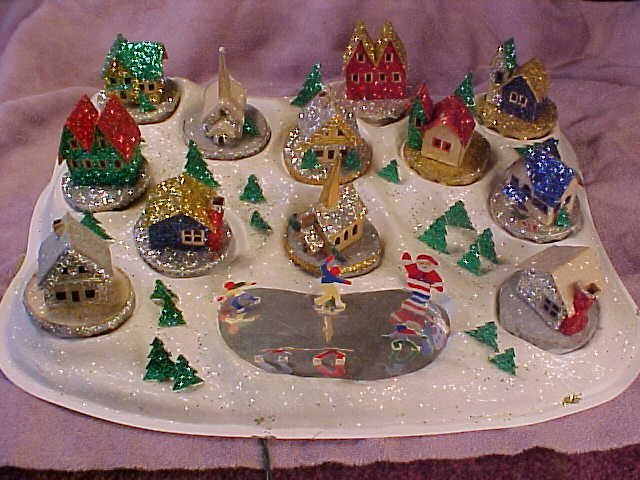
This entire little world is just 17" wide by 13" deep.
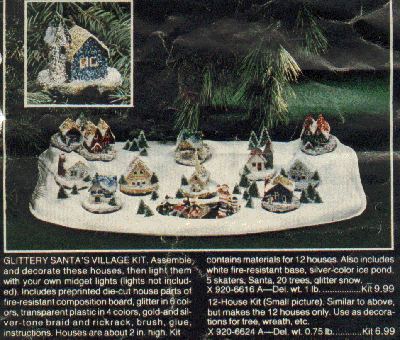
I have included these partly as a continuance of a thread of house-type lights that runs throughout the history, and because they're probably the only two items of any quality and interest that come out of the '60's. I'd like to see a complete boxed set of these little "German" covers sometime - just to satisfy my curiousity as to who made them. Were they also ready made or only a kit? I've heard both versions.
 The Magic Window
My daughter read what I said about the "death of the American Christmas" and disagreed. She said "I dunno, Dad - I was born in '62 (I knew that) and Christmas was just magical and wonderous for me." And, of course, it was. There is but a very brief window in early childhood for us all - a period of time that lasts from birth until we are cast from the nest and into public school - a time while we still have one foot in Heaven and all about the world is new and good. A time when we are so open. A time when we take things so deeply in that they will form us ever after. So we imprint upon the Christmas of our time, and what that was is what it will be for us
always.
The Christmases we've always had were always shaped by Christmases that came before - from the Christmases of parents and near family, always trying to remake the magic for us that they had known... hoping to see again through our new eyes and re-enter - if just in little flashes - the now closed Window. Of course, people don't throw out all the decorations after Christmas every year and buy everything new the following. Who's trunks of trimming treasure was not filled with items that were lost friends found anew each Season? - which elicited the same annual remarks such as "My FAVORITE!!" - and -"This was my grandmother's and her mother gave it to her.... So - much is carried forward year by year and generation to generation.
Had I one magic ticket to traverse Time and relive one decade of the 20th Century, I'd choose the Thirties. I was born in '41 - 6 months before Pearl Harbor. Christmas practices had not yet changed. The Christmases of my Magic Time were very much the Christmases as they were from then, from my mother's time: the '20s and the 30's. The Thirties fascinate me. They call to me to know them...the most complex and paradoxical of times .. the Great Depression and the Duesenbergs - bread lines, Labor Wars and the most fabulous Christmas things that were ever made. The largest and most luxurious electric trains and toys... locomotives so large a small child could not lift one from the track! Hobos!The rise of radio. Art Decco. The Empire State Building and the great zeppelins. The talking movies. Aviation. Whole regions of the country getting electricity and indoor plumbing for the first time. An unquestioned faith in the future of technology at a time when many had an outhouse in the back and the most menial of jobs if a job at all. My Mom and Dad lived those times. I had the Christmases they made. I heard their talk. There were qualities about them that made me want to be where they had been see what they had seen. Qualities you rarely see in postwar people ....
I think that that is what collecting is about, especially for those who collect for love and not for sterile speculation. This is most true of the toys and trappings of Christmas. Artifacts. Actual, tangiblecontacts with our Special Time. It is true that we forget nothing. The power that an object unseen in decades can have to transport us in mind and spirit back to a specific period or moment of our lives - to unlock long-closed doors in the mansion of our memory - is the true value that it has. We can hold such an object in our hands and know those times were real, and welcome back whole parts of who we were into who we are ...and let the inner child in each of us out to play again - to live as part of us and help us see again through our own Magic Window .
So, God bless us every one, and AMEN! Reality be damned! This is CHRISTMAS! You will find that those old objects will take you back in time, but never listen to those sad fools who say that you are "living in the past." We are what we are because of our pasts. Would that we could! But we can bring them forward, to live within us as we face the present and the future. Those pasts taught us everything we know.
Never be ashamed of your nostalgia ...it was, and is, your reverence for the life you had,
- the path that you have traveled
. "Papa" Ted
| Categories |
| Main Page |

|
announcements, will remain exactly as Ted left it in October, 2012. The archive is kept online with the help of volunteers from:
|